 Jobber
 QuickBooks
 Wisetack
 Goodman
The situation
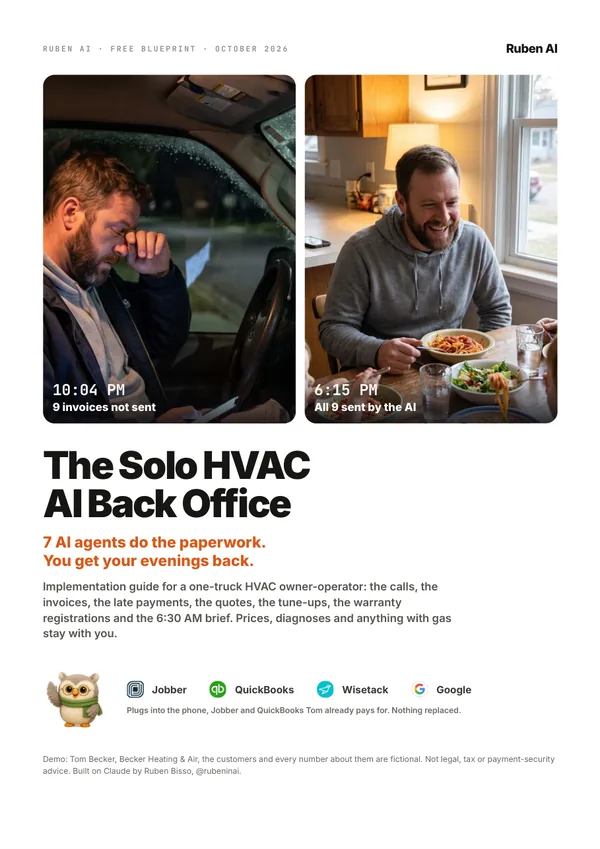
Tom Becker runs Becker Heating & Air alone: one van, his phone, Jobber for jobs and invoices, QuickBooks for the books. He is good at the work. His first call on the first hard freeze is a furnace whose burners light, then shut off: a dirty flame sensor, twenty minutes to fix.
The work around the job is the problem. Owners of HVAC shops with fewer than ten people say they spend more than fifteen hours a week on paperwork, according to HVAC School's 2025 survey. And the phone does not wait: Invoca's 2026 benchmark found that only about half of home-service calls reach a person. When Tom is in an attic, his phone rings in his pocket.
By ten that night he is still in the van, with a voicemail from a customer whose kitchen is at 58°F and nine invoices he has not sent.
How the day used to go
Calls go to voicemail while he works, and he returns them between jobs, if the caller has not already found someone else. Invoices get written in the evening, from memory and receipts on the passenger seat. Late payments get chased when he remembers. Quotes he wrote last week go cold because nobody follows up, and the warranty card for Tuesday's new furnace sits in the glovebox.
Nearly three in five small businesses carry invoices more than 30 days overdue, according to Intuit's 2026 late payments report. For a solo shop, that is the money for next week's parts.
The agents
Seven agents, one per job. Tom keeps his phone, Jobber and QuickBooks; the agents plug into them.
 Claude, the agents